
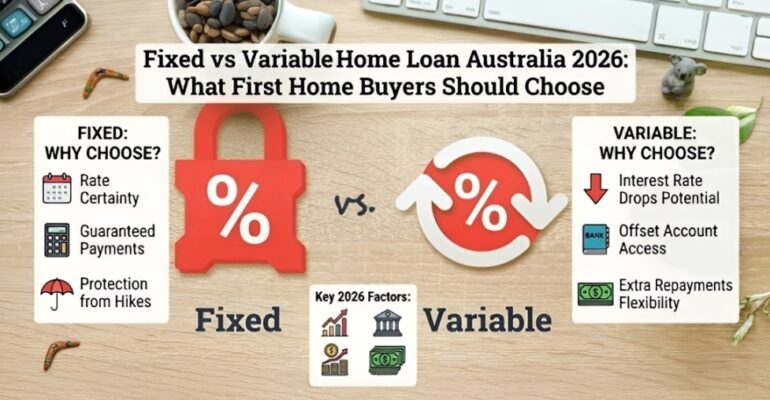
Fixed vs Variable Home Loan Australia 2026: The Smart Decision Framework for First Home Buyers
Introduction: One of the Most Consequential Decisions You’ll Make
Of all the decisions involved in getting your first home loan, the fixed versus variable choice is one of the most consequential — and one of the most frequently misunderstood.
Too many first home buyers approach this decision emotionally: choosing fixed because they feel anxious about rate rises, or choosing variable because someone told them variable is always better long-term. Neither instinct is wrong — but neither is a complete strategy.
In May 2026, with the rate environment in a genuine transition phase, this decision carries particular significance. Understanding it properly — including the nuances, trade-offs, and practical implications — will help you make a choice that actually matches your financial reality rather than your feelings.
This guide gives you the complete picture: a clear explanation of how each loan type works, an honest assessment of the advantages and risks of each, a direct comparison across every dimension that matters, and a practical framework for making the right choice for your specific situation.
Understanding Fixed Rate Home Loans: Complete Picture
A fixed rate home loan is a mortgage where the interest rate is locked at a specified level for a defined period — typically between 1 and 5 years in Australia. For the duration of that fixed term, your rate does not change regardless of what the RBA does or what happens to market rates.
How Fixed Rates Actually Work
• Your rate is agreed at the time of loan settlement
• It stays exactly the same for the agreed fixed period
• At the end of the fixed term, the loan reverts to the lender’s standard variable rate
• If you exit a fixed loan early, break costs apply — and these can be substantial
• Most fixed loans have significant restrictions on extra repayments and redraw
The Genuine Benefits of Fixing Your Rate
Benefit | Explanation | Who It Matters Most For |
Complete repayment certainty | You know your exact repayment every month for the fixed term | Buyers on tight budgets, single income households |
Protection from rate rises | If rates rise after you fix, you are fully insulated | Buyers who believe rates will increase |
Budget predictability | No surprises — easy to plan household finances | Anyone who values stability over flexibility |
Psychological comfort | Eliminates rate anxiety completely for the fixed term | First home buyers adjusting to mortgage repayments |
The Real Limitations of Fixed Loans
Limitation | Practical Impact | Severity |
Break costs if you exit early | Can be $0 or tens of thousands depending on market movement | High — must calculate before committing |
No benefit if rates fall | You remain locked at your rate even if market rates drop | Medium — depends on rate direction |
Extra repayments restricted | Most fixed loans allow only ~$10K/year extra repayments | Medium — limits debt reduction opportunity |
Limited or no offset access | Most fixed loans don’t offer full offset functionality | High — significant opportunity cost |
Reverts to SVR at end of term | Standard variable rates are often not competitive | Medium — requires review at end of term |
Understanding Variable Rate Home Loans: Complete Picture
A variable rate home loan is a mortgage where the interest rate moves in response to market conditions — primarily the Reserve Bank of Australia’s cash rate decisions, but also influenced by each lender’s own funding costs and competitive positioning.
How Variable Rates Actually Work
• Your rate starts at the agreed level but can change at any point
• Rate changes are typically announced by the RBA on the first Tuesday of each month
• Lenders decide how much of each RBA movement to pass on — and when
• Variable loans typically include full offset account access
• Extra repayments are generally unlimited
• Redraw facilities allow access to any extra repayments you’ve made
The Genuine Benefits of Variable Loans
Benefit | Explanation | Financial Value |
Full offset account access | Every dollar in offset reduces daily interest calculated | Extremely high — tax-free return at mortgage rate |
Unlimited extra repayments | Pay down debt as fast as your cash flow allows | High — reduces total interest paid significantly |
Rate cut benefits | If rates fall, your repayments fall automatically | High — depends on rate direction |
No break costs | Exit, refinance, or restructure at any time without penalty | High — complete flexibility |
Redraw access | Access extra repayments if needed for genuine emergencies | Medium — provides liquidity without separate savings |
The Real Risks of Variable Loans
Risk | Practical Impact | Management Strategy |
Rate rise exposure | Monthly repayments increase — potentially significantly | Hold buffer of 15%+ above current repayment |
Budget uncertainty | Difficult to predict exact monthly outgoings | Build flexibility into household budget |
Requires active monitoring | Should review rate periodically vs market | Annual broker review — set calendar reminder |
The Complete Head-to-Head Comparison
Feature | Fixed Rate | Variable Rate | Advantage |
Repayment certainty | Complete certainty | Changes with rate movements | Fixed |
Rate cut benefit | None during fixed term | Immediate benefit | Variable |
Rate rise protection | Complete protection | Fully exposed | Fixed |
Extra repayments | Typically limited to ~$10K/year | Unlimited | Variable |
Offset account | Limited or none | Full access | Variable |
Break costs | Yes — potentially significant | None | Variable |
Exit flexibility | Very low | Very high | Variable |
Budget simplicity | Easy to plan | Requires buffer planning | Fixed |
Best rate competition | Available at time of fix only | Can refinance anytime | Variable |
Overall flexibility | Low | High | Variable |
The Split Loan Strategy: Why It’s the Most Popular Choice in 2026
A split loan divides your total mortgage balance between a fixed portion and a variable portion. This approach has become the most commonly recommended structure for first home buyers in 2026 — and there are sound strategic reasons for its popularity.
By splitting your loan, you capture the core benefits of both approaches while limiting the impact of the disadvantages of either.
How a Split Loan Works in Practice
Loan Amount | Fixed Portion | Variable Portion | What Each Provides |
$700,000 | $420,000 (60%) | $280,000 (40%) | Stability on majority; offset/flexibility on rest |
$700,000 | $350,000 (50%) | $350,000 (50%) | Balanced approach — equal certainty and flexibility |
$700,000 | $280,000 (40%) | $420,000 (60%) | Flexibility-weighted — better if rates expected to fall |
The variable portion carries your offset account — so you still get the interest-saving benefits of parking savings against your loan. The fixed portion gives you repayment certainty on the majority of your debt. Neither approach is compromised beyond the split.
For most first home buyers in May 2026, a split loan at roughly 50–60% fixed / 40–50% variable represents the most balanced and practical structure. It manages uncertainty without sacrificing the offset benefits that save significant interest over time.
The Decision Framework: How to Choose What’s Right for You
Rather than prescribing a single answer, the right structure depends on your specific answers to these questions. Work through them honestly.
Question | If Your Answer Is… | Suggests… |
Can I handle repayment increases of $400–500/month? | No — this would cause real stress | Fix a larger portion (60–70%) |
Do I have significant savings to hold in offset? | Yes — $30,000+ available | Keep a larger variable portion for offset benefit |
Do I plan to stay in this property for 5+ years? | Yes, definitely | Either structure works — consider a 2–3yr fix |
Am I likely to sell or refinance within 2 years? | Possibly | Favour variable — avoid break cost risk |
Is my income stable and predictable? | Yes — permanent PAYG | Can absorb more variable exposure |
Is my income variable or uncertain? | Somewhat — commission/bonus based | Fix more to reduce repayment unpredictability |
Do I believe rates will fall significantly in 2026? | Yes | Favour variable — capture cuts |
Am I uncertain about the rate direction? | Yes | Split loan is designed precisely for this scenario |
Important: Fixed Rates Available to You Right Now vs Predictions
One of the most common mistakes buyers make is comparing their available fixed rates against their own predictions about where variable rates will go. This is genuinely difficult to get right — and even professional economists with institutional resources frequently get it wrong.
Fixed rates currently offered by lenders already incorporate market expectations about future rate movements. They are not arbitrarily priced. If the market broadly expects rate cuts, fixed rates will typically already be priced below current variable rates — which is what you see reflected in current products.
So rather than trying to outsmart the market with your rate prediction, focus on the question: does the certainty value of a fixed rate justify its cost to me, given my specific financial circumstances? That’s a question only you can answer — and it’s a much more tractable one.
What Happens at the End of a Fixed Term?
This is a step that many first home buyers don’t think about when entering a fixed loan — and it becomes an important decision point when the fixed term expires.
When your fixed term ends, your loan automatically reverts to the lender’s standard variable rate — which is typically not the most competitive rate available. At this point you have clear options:
• Negotiate directly with your current lender for a competitive ongoing rate
• Fix again if rate certainty still appeals and conditions support it
• Refinance to a different lender if a better product is available elsewhere
• Move to variable fully if the flexibility and offset benefits are now the priority
The key action: set a calendar reminder for 30–60 days before your fixed term ends. Do not let your loan roll onto the revert rate without reviewing your options. This is one of the most reliably avoidable costs in Australian mortgage management.
Final Thoughts: The Right Structure Is the One That Lets You Sleep — and Still Grow
There is no universally correct answer to the fixed versus variable question. Anyone who tells you otherwise is oversimplifying.
What matters is building a loan structure that genuinely fits your income stability, your risk tolerance, your savings habits, and your medium-term plans. A structure that manages uncertainty without sacrificing the tools that build wealth over time.
For most first home buyers in May 2026, that answer sits somewhere in a thoughtfully constructed split loan — with enough fixed exposure to provide genuine certainty, and enough variable exposure to capture the full offset benefit that saves meaningful money over the life of the loan.
Don’t choose based on fear or enthusiasm. Choose based on a clear understanding of your own situation — and with guidance from someone who knows the full landscape of available products.
Not sure whether to fix, go variable, or split? Get a personalised loan structure analysis, rate comparison across 30+ lenders, and a complete repayment modelling exercise. Connect with a specialist mortgage broker today and make this decision with full confidence.