
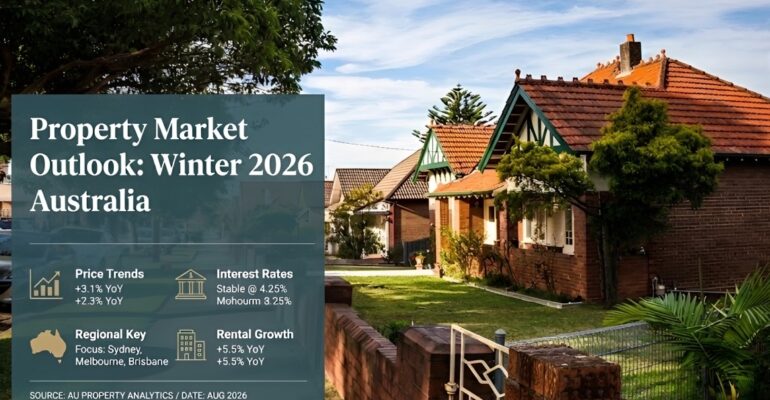
Property Market Outlook: Winter 2026 Australia
A Comprehensive Analysis of the Australian Property Market as Winter 2026 Begins | June 2026
Introduction: A Market at a Crossroads
The Australian property market enters winter 2026 in a state of significant flux. Three RBA rate hikes in the first five months of the year have returned the cash rate to 4.35%, reversing the stimulus of 2025’s cuts and introducing a new layer of complexity for buyers, sellers, and investors. Yet the fundamental drivers of Australian property — population growth, supply shortages, and structural housing undersupply — remain firmly in place.
The result is a market that defies simple characterisation. Sydney and Melbourne are unmistakably softer, with auction clearance rates at multi-year lows and vendor discounts widening. Perth continues to run at a pace that seems disconnected from the broader rate environment. Brisbane and Adelaide hold firm. Regional markets are fragmenting.
This outlook provides a comprehensive, city-by-city and segment-by-segment analysis of where the Australian property market stands in June 2026, the forces shaping it, and what buyers, sellers, and investors should expect as Australia moves through winter and into the second half of the year.
Part 1: The Macro Context — Forces Shaping Winter 2026
1.1 Interest Rates: Still the Dominant Force
No force has shaped the Australian property market in 2026 more than interest rates. The RBA’s decision to hike to 4.35% in May 2026 — the third increase of the year — came as a genuine shock to many market participants who had expected rates to stabilise following the 2025 cut cycle.
The hike was driven by persistent inflation: rising rents, insurance costs, energy prices, and a labour market that has remained tighter than the RBA expected. The Board’s assessment that ‘inflation is likely to remain above target for some time’ has signalled that the cycle of hikes may not yet be over. The June meeting (16 June 2026) will be closely watched, with NAB forecasting one more hike and Westpac projecting rates reaching 4.85% by September.
The practical property market implications are well-documented: each 0.25% rate rise reduces typical borrowing capacity by approximately $10,000–$15,000 on average income. With three hikes already absorbed, the cumulative reduction in borrowing capacity since early 2026 has been $30,000–$45,000+ — a meaningful constraint on what buyers can bid for property.
Buyer sentiment reflects this reality. The Westpac-Melbourne Institute ‘time to buy a dwelling’ index fell to 82.9 in March 2026 — a new cycle low and well below its long-run average of 120. The deterioration was most evident among existing mortgage holders, who are simultaneously managing higher repayments on their current debt while trying to assess whether it’s a good time to purchase additional property.
1.2 Supply and Demand: The Underlying Support
Despite the rate headwind, Australian housing markets retain structural support from supply-demand fundamentals that have not fundamentally changed:
- Population growth continues, driven by immigration that has remained elevated through 2025 and into 2026. Each year, Australia adds hundreds of thousands of residents who need housing.
- Rental vacancy rates remain extremely tight across all major markets. CBRE estimates capital city vacancy rates at 1.8% in 2025, forecast to fall to 1.1% by 2030 as rental demand continues to outpace supply.
- New supply is constrained by high construction costs, trade shortages, planning delays, and builder risk — all of which have limited the residential building pipeline’s ability to respond to demand.
- Building approvals data shows some improvement — approvals were up 14% year-on-year in February 2026 — but the pipeline of completions lags the pace of demand addition by a significant margin.
These fundamentals explain why the market has not experienced the sharp corrections that some analysts predicted when rates began rising. Supply shortages act as a floor beneath prices even when demand is constrained by affordability and borrowing capacity.
1.3 APRA’s Role in Shaping Market Access
The Australian Prudential Regulation Authority’s tightening of high-DTI lending rules from February 2026 has added a structural constraint on market activity at the margin. Lenders are limiting the proportion of new lending at high debt-to-income ratios, which effectively excludes a segment of would-be buyers — particularly in high-price markets where the property value relative to income necessarily produces high DTI ratios.
The practical effect has been most felt in Sydney, where median property prices require high DTI borrowing for most middle-income buyers. This constraint, layered on top of the affordability pressure from higher rates, explains much of Sydney’s subdued clearance rate and widening vendor discount.
Part 2: City-by-City Outlook — Winter 2026
2.1 Sydney — Buyer’s Market Conditions
Sydney enters winter 2026 as the most accessible it has been for buyers in years. Auction clearance rates have fallen to or near pandemic-era lows — preliminary rates touching 49% in recent weeks. The combined capitals median vendor discount has widened to 3.1%. Properties are taking longer to sell, and buyers with pre-approval and genuine capacity are in a position of negotiating power not seen since 2019.
The units segment in Sydney warrants particular attention. After years of underperforming against houses, units have been gaining ground as affordability constraints push buyers toward more attainable property types. With rental yields strengthening as vacancy rates remain tight, the case for inner-city Sydney units — particularly for investors — is improving.
Looking ahead through winter 2026, the Sydney market is likely to remain at or near current subdued levels until clarity on the rate path emerges. A pause or reversal from the RBA would likely catalyse a recovery; a further hike in June would extend the buyer’s market conditions. For those who can transact — with strong pre-approval and capacity — this is among the best entry conditions of the decade for Sydney property.
2.2 Melbourne — Weighing Under Multiple Pressures
Melbourne’s property market in winter 2026 carries the weight of multiple compounding pressures: high interest rates, a weak state economic outlook, elevated land taxes for investors introduced over recent years, and affordability constraints that have bitten harder than in most other markets.
Auction clearance rates are holding in the high 50s — better than Sydney’s preliminary figures, but still below the 65%+ threshold that signals genuine seller strength. Supply remains elevated in many middle-ring suburbs, giving buyers real choice. Properties with defects or that require significant work are sitting on market for extended periods at significant discounts.
One counterpoint for Melbourne: the investor retreat driven by land tax changes has created genuine buying opportunities in the middle ring. Properties that were investment-grade five years ago are now selling for less than their construction replacement cost in some cases. For owner-occupiers who can look past the current sentiment weakness, Melbourne’s winter 2026 offers compelling value in specific suburbs with strong fundamentals.
The medium-term case for Melbourne remains sound: Australia’s second-largest city, with world-class liveability, a diversified economy, and infrastructure investment continuing. The near-term softness is real, but likely temporary.
2.3 Brisbane — Continued Strength, Selective Opportunities
Brisbane has maintained its position as a relative outperformer through 2026’s rate cycle, supported by continued population growth from interstate migration, a more affordable base than Sydney and Melbourne, and the ongoing infrastructure investment pipeline associated with the 2032 Olympics.
Property prices in Brisbane are expected to outpace annualised wage growth through 2026 according to CoreLogic projections, even as the rate environment constrains national momentum. For buyers, this means the window for ‘value’ entry into Brisbane is narrowing, but the market remains more accessible than Sydney and Melbourne on a comparative basis.
The Brisbane units market is worth monitoring. After years of oversupply concerns in the inner city, vacancy rates have tightened and rent growth has been strong. New apartment delivery has slowed due to construction cost pressures, setting up a potential supply deficit in the medium term.
2.4 Perth — Running Its Own Race
Perth’s property market in winter 2026 continues to operate largely independently of the national rate environment. Properties are selling in days at record prices, with one market analyst describing conditions as ‘as tight as they get.’ Perth prices are expected to increase by more than 12% over the 12 months to January, according to projections based on late 2025 trajectories.
The divergence from Sydney and Melbourne reflects Perth’s specific fundamentals: a resources sector-driven economy that has remained strong, significant underbuilding relative to demand through the 2016–2020 period that created a structural deficit, and a price base that remains meaningfully below Sydney and Melbourne even after recent strong growth.
For buyers in Perth, the challenge is competition and speed. Pre-approval is essential, and buyers need to be prepared to move within days of a listing appearing. For investors considering entering the Perth market from the eastern states, the strong rental yields and capital growth momentum are compelling, but the entry price has increased significantly from two years ago.
2.5 Adelaide — Steady Performer
Adelaide continues its run as a steady outperformer, with consistently strong auction results relative to the national average. The city’s more affordable property prices relative to Sydney and Melbourne, combined with solid local economic conditions and population growth, have insulated it somewhat from the national rate headwind.
Adelaide’s prestige market — the Hills and premium beach suburbs — has been the strongest performer, but the more accessible suburbs in Adelaide’s middle ring also continue to see solid activity. For buyers, Adelaide remains the most accessible major capital city market in Australia, with a median house price well below the eastern state capitals.
2.6 Regional Markets — Fragmenting Picture
Australia’s regional markets have fragmented significantly from the uniform outperformance seen during the pandemic period. The tailwinds — remote work flexibility, relative affordability versus cities, lifestyle appeal — have faded for some markets while remaining intact for others.
Regional markets with strong local economic drivers (mining towns in WA and QLD, regional centres with major hospital or university employment anchors, coastal markets within commuting distance of capital cities) continue to perform well. Markets that were purely pandemic-driven, without those underlying economic anchors, are experiencing correction as buyers return to capital cities and remote work norms settle.
For investors, the regional market now requires genuine research rather than the broad market exposure that worked during 2020–2022. Vacancy rates, local employment data, and infrastructure investment are the key differentiators.
Part 3: Segment Analysis — Houses, Units, and Investment
3.1 The House vs Unit Value Gap
One of the notable dynamics of the post-pandemic period has been the widening gap between capital city house and unit values. Capital city house values rose almost three times as much as unit values since the onset of COVID. This gap has been narrowing in 2025–2026, as affordability constraints push buyers toward more attainable price points and the units market gets partial relief from strong rental yields.
For buyers, the narrowing gap represents an opportunity: in markets like Sydney and Melbourne, the additional cost of buying a house versus a unit has extended well beyond any functional premium. Units in strong inner-city locations with genuine amenity — particularly those in buildings with manageable strata levies and quality construction — represent relative value in the current market.
3.2 The Investment Property Landscape
For investors, winter 2026 is a test of financial resilience and strategic clarity. The May rate hike to 4.35% compresses yields, and the Westpac scenario of 4.85% by September would compress them further. Yet the softening Sydney and Melbourne markets are offering yields not seen since 2022, with vendor discounts widening and auction competition reduced.
The investment property decision framework for winter 2026:
- Existing investors: Focus on portfolio health — debt structure, IO expiry dates, rate competitiveness, and cash flow under stress scenarios. Properties with persistent underperformance (yield below 3%, minimal capital growth over 5 years) should be reviewed seriously.
- New investors: The buyer’s market conditions in Sydney and Melbourne create genuine entry opportunities, but serviceability remains demanding at 4.35% cash rate with APRA’s 3% buffer. Strong cash flow, substantial deposit (ideally 20%+), and a clear investment thesis are prerequisites.
- Interstate investors (Perth, Brisbane, Adelaide): Markets remain competitive, but yields have improved from recent lows. Entry costs are higher than 12–18 months ago.
3.3 The Rental Market — Tenant Pressure, Investor Opportunity
Australia’s rental market remains under extreme pressure. Vacancy rates in capital cities are at historic lows, with CBRE forecasting further tightening to 1.1% by 2030. CBRE also projects median apartment rents to grow by 24% between 2025 and 2030 across capital cities, with 92% of 2-bedroom apartments forecast to exceed $700 per week by 2030.
For tenants, this is a genuine affordability crisis. For property investors, it creates a foundation of strong rental income that supports yield calculations even at higher interest rates. The investment case for well-located, residential property in undersupplied markets is underpinned by this rental market reality.
Part 4: What to Watch in H2 2026
4.1 The June RBA Decision
The most immediately market-moving event will be the RBA’s June meeting decision (announced 16 June 2026). Another 25 basis point hike — the scenario NAB currently forecasts — would further compress borrowing capacity and extend the soft market conditions in Sydney and Melbourne. A hold decision would provide the market with a degree of certainty and could catalyse activity from the pool of buyers who have been waiting on the sidelines.
Any signal from RBA Governor Michele Bullock that the rate cycle has peaked could be a significant catalyst for market recovery — particularly in Sydney and Melbourne where buyer sentiment is the primary restraint, not an absence of underlying demand.
4.2 Construction Pipeline and Supply
Building approvals data is improving, but the pipeline of completions lags demand. Construction costs remain high, and the building sector continues to face trade shortages. Any improvement in supply delivery — particularly of multi-unit residential properties — could provide some relief to the most supply-constrained segments of the market.
The government’s commitment to constructing 100,000 homes for first-home buyers (scheduled to commence construction in 2026–27 with occupancy from 2027–28) is a potential medium-term supply addition, though the timeline means limited short-term market impact.
4.3 Migration and Demand
Australia’s population growth — driven significantly by net overseas migration — remains the fundamental engine of housing demand. If migration numbers remain elevated through the second half of 2026, the demand base for housing continues to build even as rate-driven affordability constraints limit active buyer numbers at any point in time.
The dynamic creates a potentially interesting situation for the back half of 2026: population-driven latent demand building up during a period of rate suppression, potentially releasing strongly if and when rates turn. Investors positioned ahead of any rate cycle turn may benefit from this accumulated demand effect.
Part 5: Strategic Guidance for Winter 2026
For Buyers
- Sydney and Melbourne: If you have pre-approval and genuine capacity, this is the strongest buyer’s market in years. Negotiate hard, expect vendor discounts, and don’t be rushed.
- Perth and Adelaide: Be prepared to move quickly. Competition remains high. Pre-approval and readiness to act within days of a listing are essential.
- Across all markets: Stress-test your repayments at 5% and 5.5%. Buy what you can genuinely service under a continued rate-rise scenario.
- Don’t wait for ‘perfect’ conditions: Timing the market perfectly is impossible. Buying quality property in quality locations at a fair price remains a sound long-term strategy regardless of short-term rate cycles.
For Sellers
- Sydney and Melbourne: Price to the current market, not to peak values. Overpriced properties are sitting while realistically priced properties are still selling. Work with an agent who has current comparable sales data.
- Presentation matters more in a buyers’ market: Quality photography, styling, and presentation become more important when buyers have more choice.
- Consider your timing: The spring selling season (September–November) typically brings more buyers back to the market. If you can hold to spring, conditions may improve.
For Investors
- Review portfolio health now: Debt structure, IO expiry dates, rate competitiveness, and cash flow scenarios. The cost of inaction is measured in real monthly dollars.
- The entry opportunities in Sydney and Melbourne are genuine: For investors who can service at current rates with appropriate deposit, the buyer’s market conditions represent a rare window.
- Focus on cash flow quality: In a high-rate environment, yield matters. Properties with strong rental income and low vacancy risk are preferable to speculative capital growth plays.
Conclusion: A Market of Complexity and Opportunity
The Australian property market in winter 2026 is not one market — it is many. Perth runs hot while Sydney cools. Unit values catch up to houses in some cities. Investors manage cash flow pressure while rental markets tighten further. Buyers in Sydney and Melbourne find negotiating power they haven’t had in years.
The next six months will be shaped by the RBA’s rate decisions, the migration pipeline, the construction sector’s ability to deliver supply, and the confidence of buyers and sellers to transact in an environment of uncertainty. Those who understand the specific dynamics of their city, segment, and financial position — and act with clarity and discipline — will find genuine opportunities in this complex landscape.
Winter 2026 is not the time for paralysis. It is the time for informed decision-making, strategic positioning, and careful execution.