
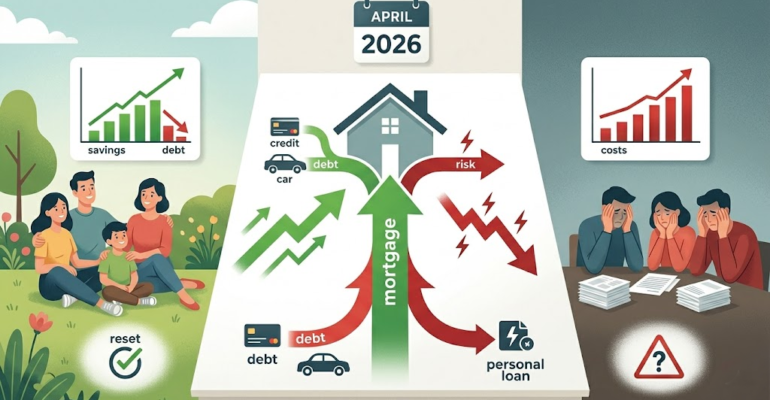
Debt Consolidation Through Your Mortgage in April 2026 — Smart Reset or Expensive Mistake?
Primary Keyword: Debt consolidation mortgage Australia
Secondary Keywords: consolidate debt into home loan, refinance debt Australia, mortgage debt strategy 2026, managing high interest debt
Introduction
As household budgets remain under pressure in April 2026, more Australian borrowers are looking at debt consolidation as a way to improve cash flow. On paper, the logic is straightforward. If you have credit card debt, personal loans, or vehicle finance at higher rates than your mortgage, rolling those debts into your home loan may reduce monthly pressure and simplify repayments.
But debt consolidation is one of those strategies that can be either very smart or very costly depending on how it is done.
Used properly, it can improve control, reduce stress, and support recovery. Used poorly, it can turn short-term consumer debt into long-term mortgage debt that quietly costs far more over time.
Why Debt Consolidation Appeals in 2026
There is a reason more borrowers think about consolidation in a higher-rate environment. Household cash flow is tighter. Credit card balances can linger. Car loans and personal finance commitments can create monthly drag. When multiple debts compete at once, a mortgage refinance with consolidation may feel like an obvious solution.
And in many cases, it can help. Reducing the interest rate on high-cost debt and combining repayments into one facility can free up breathing room. That breathing room matters. Sometimes it is the difference between a household regaining control and falling further behind.
But breathing room should not be confused with a complete solution.
The Main Risk Borrowers Miss
The biggest danger with consolidation is time.
A credit card balance or personal loan might have been expensive, but at least it was designed to be shorter term. When those debts are rolled into a 25- or 30-year mortgage, the monthly repayment may fall — but if the debt is not aggressively repaid, the total interest over time can become much larger.
That means consolidation only works well when it is paired with discipline. If the borrower clears debt into the mortgage and then rebuilds the card balance again, the problem has doubled.
When Consolidation Can Make Sense
Debt consolidation may make sense if high-interest debts are putting serious pressure on monthly cash flow, the borrower has stable mortgage servicing capacity, and there is a clear plan to prevent repeat accumulation.
It can also work when borrowers use the refinance as a broader reset. That means closing unnecessary credit facilities, cancelling or reducing card limits, setting a repayment plan, and using the mortgage structure in a more intentional way.
The best consolidations are not accidental. They are structured.
Why Structure Still Matters
If debt is consolidated into a home loan, borrowers should think carefully about how it is tracked and repaid. Some may benefit from separating the consolidated portion conceptually or operationally so they can direct extra repayments to it. Others may use offset discipline or repayment targets to avoid letting the debt disappear into the mortgage balance indefinitely.
Without a structure, consolidation becomes too easy to ignore. And ignored debt is expensive debt.
Conclusion
Debt consolidation through a mortgage can absolutely help Australian borrowers in April 2026 — but only when it is treated as a reset strategy, not a shortcut.
The goal is not just to lower repayments. The goal is to improve financial control. That means reducing interest, simplifying cash flow, and building better habits so the same debt does not return.
Done properly, consolidation can create breathing room and momentum. Done carelessly, it can turn temporary debt into a decades-long burden. The difference is strategy.